
Jiho Sim
Ph.D. Student, Seoul National University
j2hosim@snu.ac.kr
MotifScreenK (MSK)
Deep learning–based virtual screening, API server (2025)
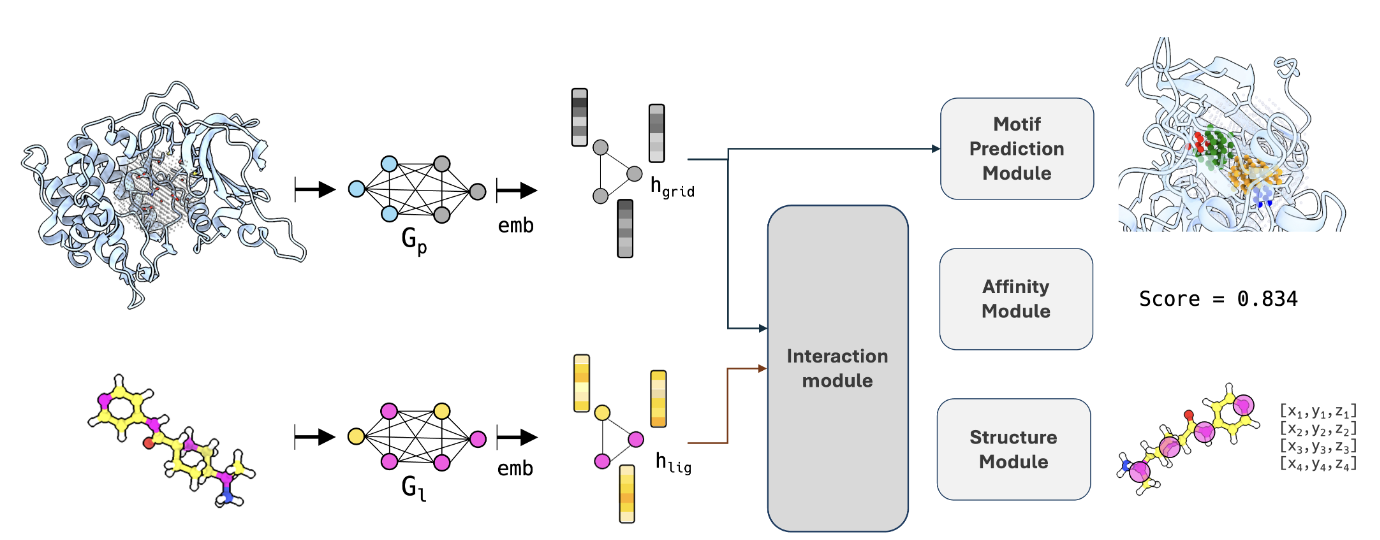
MotifScreenK (MSK) is the initial version of MotifScreen, a deep learning–based virtual screening method. It’s optimized for kinase families such as ROCK1 and served as an API.
- Web service: galaxy.seoklab.org/kaidd (see “submit msk”)
- Part of the KAIDD package (K-Artificial Intelligence Drug Discovery): www.kaidd.re.kr
Application
An initial version of MSK was applied in:
Soyeon Yoo, Kounghwa Youn, Nawoon Kim, Gyochang Keum, Hahnbeom Park, Eun-Kyoung Bang. Artificial intelligence-driven discovery of novel scaffolds for selective TLR7 antagonists and their application in enhancing mRNA translation efficiency. European Journal of Pharmaceutical Sciences, Vol. 212, 2025, 107172. doi:10.1016/j.ejps.2025.107172
Thousands of candidate TLR7-binding compounds were screened with MSK, then narrowed through ligand-docking simulations to 10 high-scoring, structurally distinct candidates. Two of these were validated as selective TLR7 antagonists with low IC50, high selectivity over TLR8/TLR9, and low cytotoxicity — and showed potential for enhancing mRNA translation efficiency.
“In this study, we employed an AI model named MotifGen (Kim et al., 2025) to identify novel hits for TLR7 scaffold. Starting from the receptor structure, the original version of MotifGen predicts the types and locations of possible binding motifs for unknown binders. An extended version of MotifGen, utilized in this work, is specifically designed for compound screening: when a ligand is provided, the AI not only predicts possible binding motifs (as in the original version) but also determines its binding probability (ranging from 0–1) to the receptor by comparing the structural and chemical compatibility with the predicted motifs. This approach allows the rapid screening of promising hit compounds from millions of chemical compound libraries at a speed of 0.01 s/molecule.”
The “extended version of MotifGen” referenced above is one of the earliest versions of MotifScreenK (MSK).